Tuesday, April 21, 2015

Cooked: A Natural History of Transformation

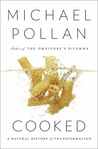
Cooked: A Natural History of TransformationCooked: A Natural History of Transformation by Michael Pollan

My rating: 3 of 5 stars


Fire, water, wind and earth - the four elements, and four different ways of filling our stomachs. Michael Pollan takes the reader on a tour of his investigation of and experimentation with food, and it is a fascinating and captivating read.

Reading about barbeque, slow-cooking meals, baking bread, and making pickles/cheese/bread through fermentation with the help of some experts in their fields brings some saliva to the mouth. There's a lot to digest (pun intended), and there's a lot of science to back up the many interesting claims and points that he raises, such as the pros and cons of pasteurization.

What I didn't like was the deep forays into his experiments, which made the book a lot longer than it needed to be. While it can be interesting to read some experiences, when they take up more than half the book, it feels like it could be cut down a bit. Limiting that to some extent, this is still a book that is well worth reading and might make you want to try out some recipes and change your eating habits too.


View all my reviews

Have Hope

Have hope

This year's Ridván message from the Universal House of Justice had a beautiful paragraph, inspiring courage and giving hope to the Bahá'ís around the world:

We wish to address some additional words to those of you in whose surroundings marked progress is yet to occur and who long for change. Have hope. It will not always be so. Is not the history of our Faith filled with accounts of inauspicious beginnings but marvellous results? How many times have the deeds of a few believers—young or old—or of a single family, or even of a lone soul, when confirmed by the power of divine assistance, succeeded in cultivating vibrant communities in seemingly inhospitable climes? Do not imagine that your own case is inherently any different.

I thought a simple picture taken by Shadi Formoso with the words "have hope" would serve as inspiration.

Friday, April 03, 2015

User Story Mapping: Discover the Whole Story, Build the Right Product

User Story Mapping: Discover the Whole Story, Build the Right ProductUser Story Mapping: Discover the Whole Story, Build the Right Product by Jeff Patton

My rating: 4 of 5 stars


Writing stories is simple, but not easy. In User Story Mapping by Jeff Patton User Story Mapping: Discover the Whole Story, Build the Right Product, we get the rundown on why doing it is a good idea, and how to do it. While it feels like story mapping is something we can just step up and start doing after hearing about it, having a guideline such as this by Jeff Patton is very helpful.

The first few chapters explain the basics, on how to get the big picture, plan for small releases and quick learning, and are really all that is needed to get started. However, reading through the latter parts of the book help understand some of the pitfalls, and guidelines on how to have a successful process. Of course, story mapping is something that might only come naturally after having done it many many times.

I like the way the narrative is written, although at times it can get a bit too jovial in the narration. Overall though, it strikes a good balance in being informative and entertaining, and is definitely worth reading if you're interested in how to develop better products.


View all my reviews

Friday, March 20, 2015

To Save Everything, Click Here: The Folly of Technological Solutionism

To Save Everything, Click Here: The Folly of Technological SolutionismTo Save Everything, Click Here: The Folly of Technological Solutionism by Evgeny Morozov

My rating: 5 of 5 stars


Whatever your thoughts are on technology and its use to solve problems, To Save Everything, Click Here: The Folly of Technological Solutionism will change your mind. And if it doesn't change your mind, it will at least make you start thinking about the Internet and blindly applying technology as a solution to every problem we face and experience.

Unfortunately I read the book over too long a period of time so my memory is quite disjointed. Evgeny Morozov spends a great part of the book looking at various ideas on how technology has been used to improve certain areas of life, and then looking at the implications of it. We realize that just because technology can help us solve a certain apparent problem (e.g. preventing jumping the turnstiles at the subway), it doesn't necessarily mean that it's a good idea. Somewhere we also need to raise the understanding and awareness of the citizens, so that they don't just become people mindlessly following whatever the latest technology fad allows or prevents them to do.

There is also great critique of the quantification of self and self-tracking, gamification, and the application of morality to technology restrictions. The style of writing can be a bit hard to read at times as there is a lot of negativity going on, but I feel that Morozov still manages to keep a positive tone, and suggesting a fair amount of alternatives. While not necessarily solutions, they're at least raising awareness of the issues involved. Should definitely be read!


View all my reviews

Thursday, March 19, 2015

What is Prayer?

What is prayer

The message of the Universal House of Justice to the Bahá'ís in Iran, dated 18 December 2014, contained a beautiful paragraph on what prayer is. Based on the paragraph, I split each sentence into a separate slide, used some beautiful photographs taken by Chad and made a small slideshow. This can be used as an inspiration for devotional meetings, Ruhi book 1, or just as a personal reflection.

Here is the extract:

The Twin Luminaries of this resplendent age have taught us this: Prayer is the essential spiritual conversation of the soul with its Maker, direct and without intermediation. It is the spiritual food that sustains the life of the spirit. Like the morning’s dew, it brings freshness to the heart and cleanses it, purifying it from attachments of the insistent self. It is a fire that burns away the veils and a light that leads to the ocean of reunion with the Almighty. On its wings does the soul soar in the heavens of God and draw closer to the divine reality. Upon its quality depends the development of the limitless capacities of the soul and the attraction of the bounties of God, but the prolongation of prayer is not desirable. The powers latent in prayer are manifested when it is motivated by the love of God, beyond any fear or favour, and free from ostentation and superstition. It is to be expressed with a sincere and pure heart conducive to contemplation and meditation so that the rational faculty can be illumined by its effects. Such prayer will transcend the limitation of words and go well beyond mere sounds. The sweetness of its melodies must gladden and uplift the heart and reinforce the penetrating power of the Word, transmuting earthly inclinations into heavenly attributes and inspiring selfless service to humankind.
You can download the What is prayer PDF.

Sunday, March 01, 2015

Monday, February 09, 2015